New Technologies cluster · Session 2 of 4
Tools Built with AI
Find it, cite it, check it, then build your own
Łukasz Szoszkiewicz
Adam Mickiewicz University, Poznań
Global Campus of Human Rights
Monastery of San Nicolò, Lido di Venezia
Before we start · Garage Research
Log in now: we build in the second half
1
Enter the seat code from your card
2
At the top, choose Session 1
3
Click through the short tour
Work in pairs if you like: one writes, the other checks. Then close the lid; we come back to it after the tools.
2 / 18
Why these tools
From Ctrl+F to open tools
2016
One Word file
A member of a treaty body showed me his innovation: all General Comments merged into one Word file, so that Ctrl+F works across them.
2022
A shared workflow
For researchers working on different committees, my scripts became one workflow in Orange Data Mining, an open visual tool.
Since 2023
Apps
With generative AI, a graphical interface on top of each script: a tool anyone can open in a browser.
Habit 2 from this morning in practice: AI helped me build the tools, but it does not answer your questions.
3 / 18
Design principles
Three rules behind all four tools
1
No answer is generated
AI helped write the software and prepare the data. Every result is verbatim text, with its UN symbol and paragraph number.
2
The paragraph is the unit
The smallest citable unit: a paragraph, a speech, a vote, a recommendation. One click copies it with its full citation.
3
One click from the source
Each result links to the official record: OHCHR, the Official Document System, the UN Digital Library.
4 / 18
One question, today and tomorrow
“Necessary in a democratic society”
Article 21 ICCPR allows restrictions on peaceful assembly only if they are necessary in a democratic society. What does that mean, where do the words come from, and what do States do with them today? The four tools in numbers →
Find
General Comment No. 37
UN Human Rights Database
TODAY
Origin
The drafting in 1952
Travaux Préparatoires
TOMORROW
Politics
Votes on peaceful protests
HRC Voting
TOMORROW
Practice
Recommendations to States
UHRI+
TOMORROW
1 · UN Human Rights Database · Find and cite
The paragraph, with its citation
Article 21 provides that any restrictions must be “necessary in a democratic society”. Restrictions must therefore be necessary and proportionate in the context of a society based on democracy, the rule of law, political pluralism and human rights, as opposed to being merely reasonable or expedient.
CCPR/C/GC/37, para. 40
Try it: search “necessary in a democratic society” → filter CCPR → open ¶ 40 → Copy citation → docs.un.org
6 / 18
1 · UN Human Rights Database · Check
Spot the two errors
The Human Rights Committee requires restrictions to be “necessary and proportionate in the context of a society based on democracy and the rule of law” (CCPR/C/GC/37, para. 41).
1 · You
Two minutes: write down what is wrong.
2 · Check
Paste the sentence: symbol resolved, paragraph checked, quotation compared with the source.
3 · Your draft
Try it on a paragraph from your own writing.
lszoszk.github.io/generalcomments → Check
7 / 18
1 · UN Human Rights Database · Ask
A question in your own words
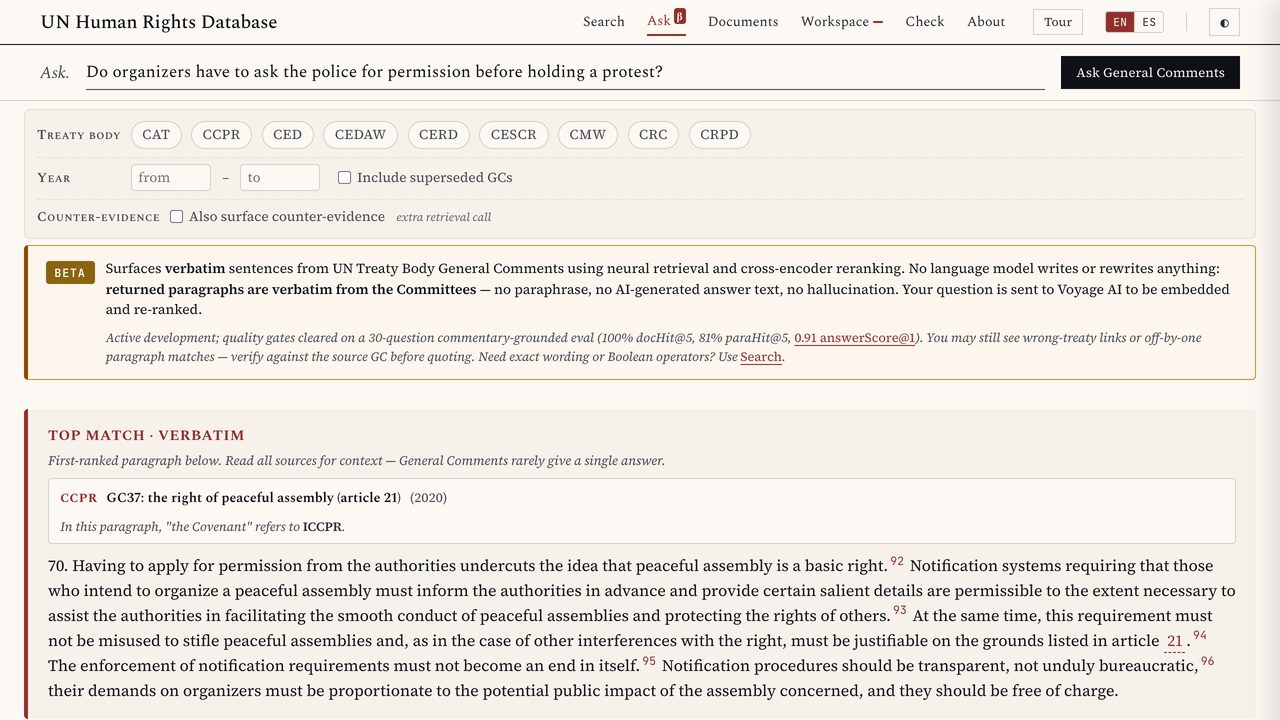
“Do organizers have to ask the police for permission before holding a protest?”
Search, where every word must appear: 0 paragraphs.
Ask, first result
Having to apply for permission from the authorities undercuts the idea that peaceful assembly is a basic right.
CCPR/C/GC/37, para. 70
A model only finds and orders the paragraphs. Every word on the screen is the Committee’s.
8 / 18
Garage Research · why it works
You can now build software in plain language, if you can check it

The tests ran out. On SWE-bench Verified (real bug reports from open-source projects) the best model solved 49% in October 2024, 81% in November 2025 and 97% in September 2026; the test was then retired as saturated.
Much new code is written this way. Google: over 25% of its new code in October 2024, 75% in April 2026 (its own figures). Independent: about 29% of new Python functions by US developers on GitHub at the end of 2024.
Why code?
Code can be run and tested: a wrong line usually shows as an error, or as a number you can check. This is AI used where it is reliable.
A programming language is a language
In one small study (36 adults learning Python), language aptitude explained more of the differences between learners than numeracy did (17% against 2%); general reasoning mattered most.
Nevertheless
In a 2025 trial, experienced developers were 19% slower with AI while believing they were faster. The checking stays with you.
Karpathy 2023 · SWE-bench · Vals AI 2026 · Daniotti et al., Science 2026 · Prat et al. 2020 · METR 2025
9 / 18
Garage Research · before you type
What may leave your laptop?
In the studio a model gets your words, a description of the file and a few sample rows. The whole file stays in your browser.
In any chatbot what you paste goes to the company that runs it. Some personal plans train on your conversations unless you switch that off.
Hands up: paste, depends, or never?
A published UPR report
Your own essay draft
An anonymised interview transcript
An NGO’s unpublished shadow report
A witness statement naming a person and a village
A complaint file with the complainant’s name
A rule of thumb: public documents may go; anything that names a person, or lets one be identified, may not; for the rest, ask whose text it is and what the tool does with it.
UN guidance on AI tools at work (2025) · ECNL 2025
10 / 18
Garage Research · how it works
The model writes the tool once, and the tool gives the answers
1 · You describe
A tool in plain words, like a chat, with a file from Your files, or a ready request.
2 · A model writes it
GLM (an open model from a Chinese lab, run in the EU) or Claude (run in the US). It sees your words, a description of the file and a few sample rows.
3 · It runs on your laptop
The code runs in your browser on the whole dataset, which never leaves your laptop.
Look inside
Run it three times: the same numbers every time? · What left this laptop: every request, what was sent and what was not
11 / 18
Garage Research · your first build · studio Session 1
A verbatim finder for the General Comments
1
From Your files, drag the General Comments into the chat.
2
Pick Verbatim finder for General Comments, answer the planning questions, and build.
3
While the model writes (a few minutes), write down what a correct result should show for “necessary in a democratic society”.
Meanwhile: how I test my own tools. Then you test yours.
12 / 18
While the model writes · how I test my tools
The answer key comes from people who cited the source
UN Human Rights Database · 389 cases
Treaty body Views that cite a General Comment paragraph for a sentence. The paragraph they cite is the answer.
Travaux Préparatoires · 579 claims
Claims about the drafting in two commentaries, Nowak (2005) and Saul, Kinley and Mowbray (2014). The record they cite is the answer.
One of the 389 cases
1 · The citation
Views CCPR/C/131/D/2635/2015 cite CCPR/C/GC/37, para. 36 for: “The onus is on States parties to justify the limitations on the right protected by article 21 of the Covenant…”
2 · Three ways to ask
The sentence as cited; a few keywords; and a question a model wrote from it:
“Who must justify limits on assembly and show they do not unduly obstruct people exercising it?”
3 · The test
Is para. 36 among the first 10 results?
Ask: first, for the sentence and for the question.
Search: nothing.
Nowak, CCPR Commentary (2005) · Saul, Kinley and Mowbray, The ICESCR: Commentary, Cases and Materials (2014)
13 / 18
While the model writes · a private benchmark
Does search by meaning find the right source?
Right source among the first 10 results. Test sentences taken from UN Views and from two commentaries, also asked as questions and as keywords.
| The query is… | UN-HRDB · Ask | UN-HRDB · Search | Travaux · Ask | Travaux · Search |
|---|---|---|---|---|
| the sentence as cited | 53% | 2% | 82% | 1% |
| a question | 42% | 0% | 73% | 1% |
| a few keywords | 34% | 9% | 26% | 45% |
In your own words: use Ask. For a few keywords, Search is better in the Travaux (45% against 26%), Ask in the UN Human Rights Database (34% against 9%).
UN-HRDB: 389 cases, 7–8 Nov 2026 · Travaux: 579 claims, 4 and 8 Nov 2026
14 / 18
Garage Research · back to your app
Does your finder find what the database finds?
1
Search “necessary in a democratic society” : is para. 40 of General Comment No. 37 among the results, as in the UN Human Rights Database?
2
Check one result by hand against the document on docs.un.org.
3
Look inside → Run it three times: the same results every time?
4
Time left? Build Check a quotation (also in Session 1) and paste the sentence from your worksheet: the same verdicts as Check in the database?
15 / 18
Tomorrow · Garage Research
Two sessions, your own tools
Session 3 · Origin and politics
The Travaux and HRC Voting, then two builds on the Council’s votes: how two States vote, and where every State stands.
Session 4 · Practice, then your choice
UHRI+, then your country’s recommendations dashboard, a research wiki from ten PDFs, or your own idea.
Everything in one place: lszoszk.github.io/teaching-materials/global-campus
Keep today’s app: Save & share → Save as file.
Before you leave
Five minutes of feedback, and one task for tonight

Anonymous, five minutes.
Open the form
Tonight: your own idea, in three sentences
Describe a tool you need for your own work (a thesis, an internship, monitoring a country): what you want to find out, which file it should use, and who will read the result.
For instance: the recommendations to your country by theme, for a shadow report; how your State votes on one topic; a checker for the quotations in a submission.
Bring a public file if you have one (a spreadsheet, a data file or a Word document). No personal or confidential data.
17 / 18
Appendix · The tools in numbers
Four tools, four official sources
UN Human Rights Database
323,000+ paragraphs: General Comments, treaty body jurisprudence, Special Procedures reports
docs.un.org
UN Travaux Préparatoires
29,694 speeches from the drafting of the UDHR, the ICCPR and the ICESCR (1946–1966), with votes and amendments
UN scans
HRC Voting
7,420 texts of the Commission, the Human Rights Council and the Third Committee; 2,736 decided by a recorded vote
OHCHR Library
UHRI+
278,000+ recommendations and observations addressed to States by UN mechanisms
uhri.ohchr.org
18 / 18