UN Treaty Bodies Search
Paragraph-level search and analysis across UN Treaty Body documents, jurisprudence, and Special Procedures

A fully static, open-source database for researching UN human rights law at the paragraph level. The platform covers General Comments, Treaty Body jurisprudence, and Special Procedures reports — all searchable by keyword, affected group, treaty body, state party, and article.
Coverage
- 187 General Comments from all 10 UN Treaty Bodies (CEDAW, CCPR, CERD, CESCR, CRC, CRPD, CMW, CAT, CAT-OP, CED)
- 4,327 jurisprudence decisions from 8 Optional Protocol treaty bodies — 98.4% of the OHCHR JURIS catalogue, including OCR-recovered scanned PDFs from the 1980s–90s
- 173 Special Procedures reports from four mandates (preview)
- 178,659 paragraphs across 4,687 documents; synchronized with OHCHR May 2026
Features
- Ask (BETA) — answers legal questions using verbatim Committee text. Rewrites queries into legal language, retrieves candidates via hybrid search (BM25 + dense embeddings), and ranks results with a cross-encoder. Independently evaluated faithfulness: 0.91 ±0.01. Returns only text the Committees actually wrote.
- Paragraph-level search with Boolean operators, filters by treaty body, year, state party, affected groups (children, women, persons with disabilities, and others), and article number.
- Clickable article references — cross-linked across General Comments and jurisprudence for navigation between related provisions.
- Document reader with bookmarking, notes, and citation tools.
- Workspace — browser-based, no data leaves your device.
- Coverage audit — public list of decisions not yet in the corpus with links to OHCHR source entries.
- Export — search results downloadable as CSV/XLSX.
Why this matters
UN Treaty Bodies have adopted over 150 General Comments and thousands of individual decisions — authoritative interpretations of international human rights law. Until recently, no tool allowed search within these documents at the paragraph level. This platform changes that, and extends the same approach to jurisprudence and Special Procedures.
Technical approach
- Fully static — runs entirely in the browser, hosted on GitHub Pages with no server required.
- All labels use deterministic regex patterns rather than LLM-generated text.
- Open-source: AGPL v3.0 (software), CC BY-NC-SA 4.0 (dataset).
- Independent of the UN; data sourced from public OHCHR repositories.
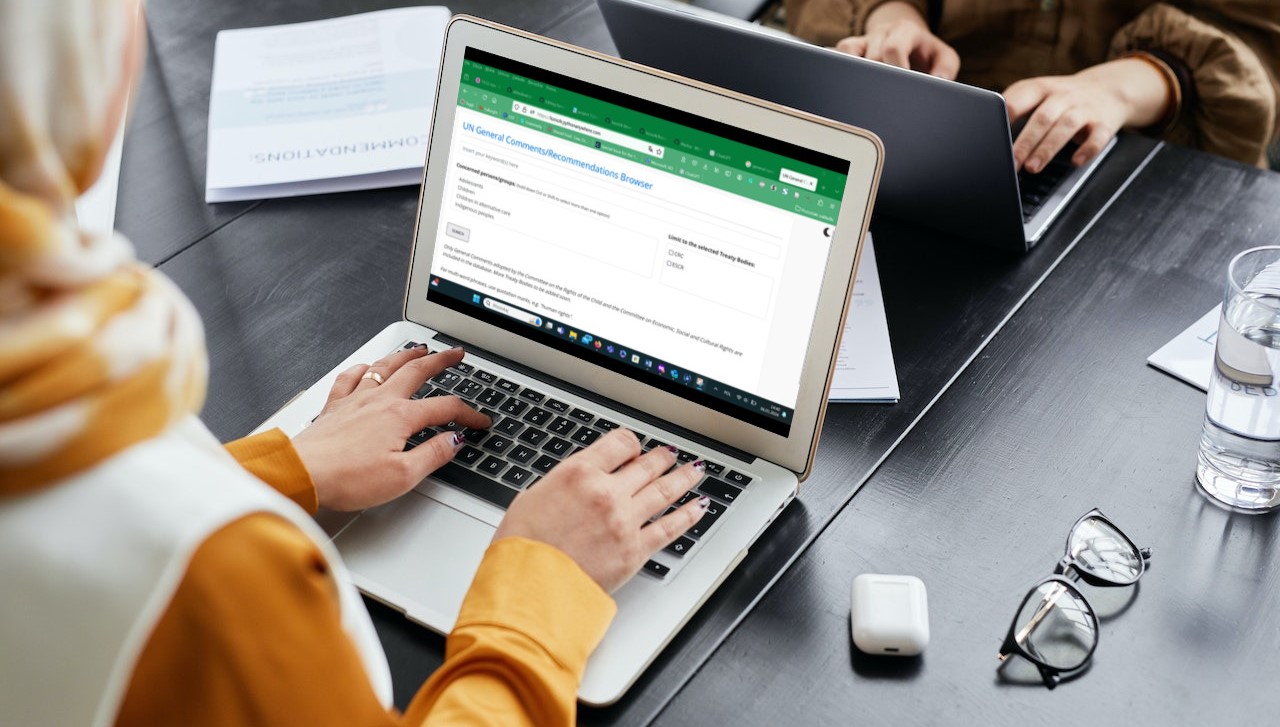
The database interface.