Łukasz Szoszkiewicz
Adam Mickiewicz University | The Neurorights Foundation | l.szoszkiewicz@amu.edu.pl

I research how AI and neurotechnologies challenge human rights law, and I build practical tools for legal and human rights research.
I am an Assistant Professor at Adam Mickiewicz University, Director for European Affairs at The Neurorights Foundation, and a 2025-26 re:constitution fellow hosted by HURIDOCS.
Previously, I was a Fulbright Scholar at Columbia University’s Neurotechnology Center, where I focused on mental privacy and speech decoding. My work combines international human rights law, legal informatics, and computational social science.
Long before the footnotes, there was the open road — I hitchhiked and backpacked across Europe, North America, and Asia, and still send the occasional dispatch to the alternative travel blog choosetravel.pl.
Tools for working with human rights law
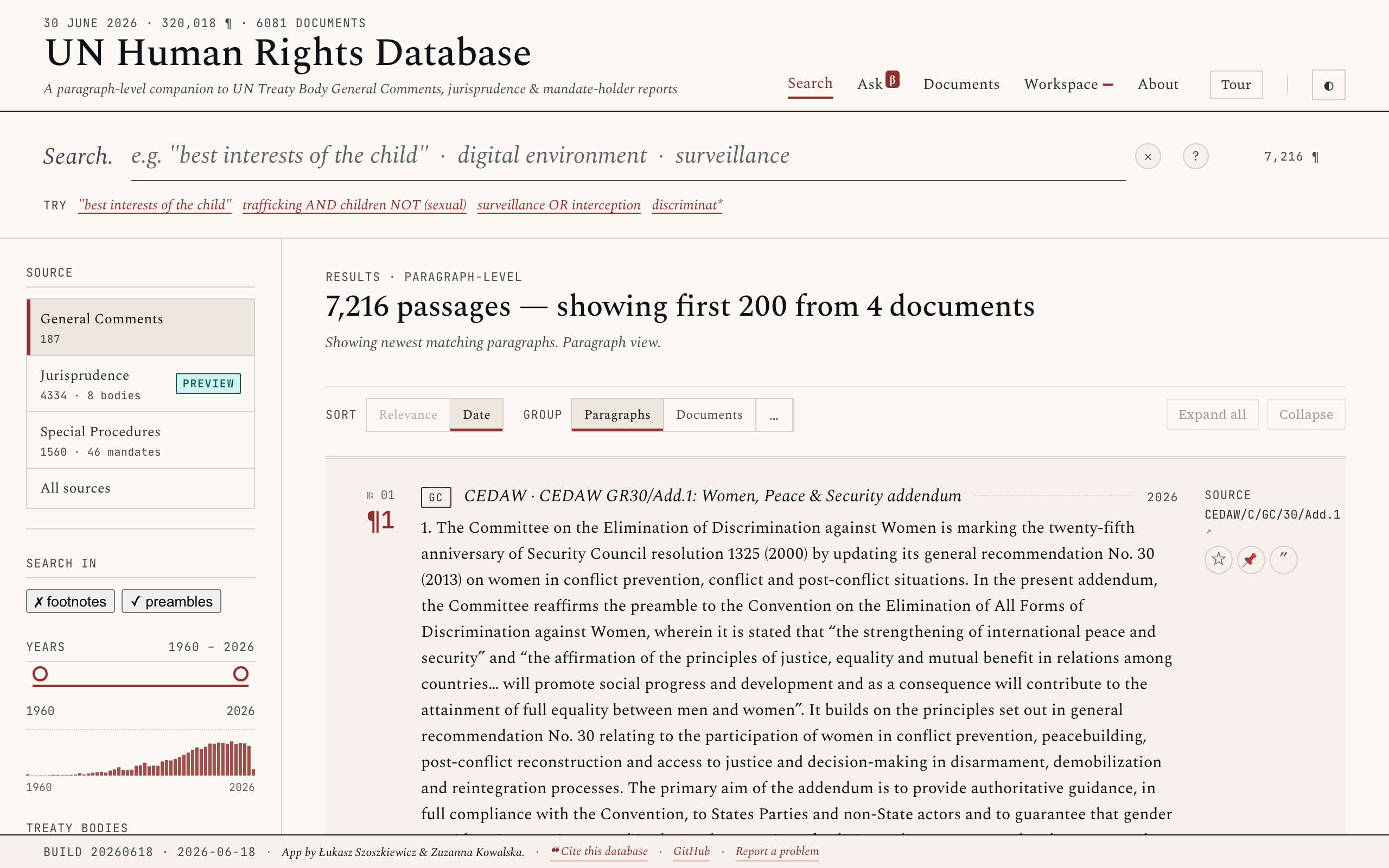
UN Human Rights Database
Search what UN human rights mechanisms actually adopted, down to the paragraph.
MCP is a connector that lets AI assistants search UNHRDB directly. Instead of inventing an answer, they can retrieve the exact UN passage, document symbol, and paragraph number.
UHRI+
The original UHRI dataset, cleaned — with visualizations and a statistics overlay across 267,000+ UN recommendations.
Open UHRI+HUDOC Researcher
Paragraph-level search of the case law of the European Court of Human Rights (over 20,000 judgments in English and over 9,000 only in French), with Semantic Search, a citation network and a Check of the citations in a draft.
Open HUDOC Researchernews
| Oct 13, 2026 | 📝 New post on the TRAFO blog of the Forum Transregionale Studien: “What the Official Databases Do Not Do: Three Open Tools for UN Human Rights Research”. It presents UHRI+, the UN Human Rights Database and HRC Voting (UHRI+ was developed within the re:constitution fellowship), and explains how human rights experts can use AI to build tools for browsing documents. |
|---|---|
| Oct 12, 2026 | 🎬 HUDOC Researcher, an independent toolkit built on HUDOC data, is now available in beta: paragraph-level search of the case law of the European Court of Human Rights, Semantic Search, a citation network and a Check of the citations and quotations in a draft (a 100-second film shows how it works). |
| Oct 3, 2026 | 🎙️ Guest of the BezReszty podcast (episode #20, in Polish): “Jak dużo wspólnego ma prawo z matematyką?” (how much do law and mathematics have in common?). We talked about AI and algorithms in legal work, whether law can be “programmed”, the ethics of using AI in the judiciary, and whether the law keeps pace with technological development. |
| Jul 17, 2026 | 🎧 New preprint: “Binaural-beat hype fails scientific scrutiny again” (Klichowski, Wicher, Szoszkiewicz et al.). In a randomised, single-blind study of nearly 2,000 adults, home-use binaural beats did not enhance — and slightly impaired — fluid-intelligence performance, with the sources of interindividual variability still unexplained. The findings indicate that the hype around these consumer neurotechnologies outstrips the evidence. You can explore the data and responses yourself in the interactive dashboard. |